Episode 2: Who Gets to Be an Author? The Authority Identity Shift
Episode Summary
In Episode 2 of the Author-ized™ Podcast, we explore the identity shift from expert to author.
Many experienced coaches, consultants, and service-based professionals hesitate to write a nonfiction book because they believe they are “not writers.” But authorship is not about writing talent. It is about authority.
In this episode, you’ll learn the 3 E’s Authority Pyramid — Experience, Evidence, and Expression — and why most experts remain excellent yet invisible. Experience gives you depth. Evidence gives you credibility. Expression gives you position.
If you’ve built real results but haven’t structured your thinking publicly, this episode will help you understand what truly qualifies you to become an author — and what decision moves you forward.
Key Takeaways
The hesitation to write a book is usually an identity issue, not a skill issue.
Being an author is not the same as being a writer.
Authority is built on three levels: Experience, Evidence, and Expression.
Most experts already have Experience and Evidence.
Expression requires a conscious decision — it does not happen by default.
Without Expression, you can remain excellent and invisible at the same time.
You become an author the moment you decide your perspective is worth structuring.
Reflection Questions
Use these to guide journaling or internal evaluation:
Where do I already have deep Experience in the problem I solve?
What Evidence can I clearly point to — results, testimonials, transformations?
Have I ever structured my thinking into a defined framework?
Where have I avoided Expression because it feels exposing?
What would change if I decided to move from private expertise to positioned authorship?
The Authority Pyramid
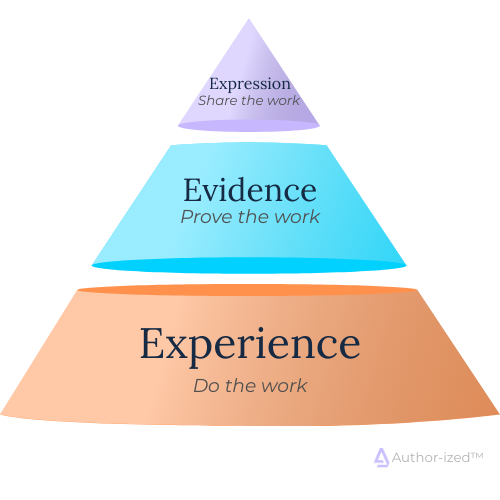
The 3 E’s of the Authority Pyramid: Experience → Evidence → Expression. Authority is cumulative — but Expression is the decision point.
Prefer to read? The full transcript is below.
Welcome to Author-ized™, the podcast for experts ready to build authority and thought leadership with their own nonfiction book. I'm your host, Ada Cuaresma. If you're a coach, consultant, or service-based expert looking to build authority in your niche or carrying a book idea but not sure where to begin, well my friend, you're in the right place.
Here we talk about structure, clarity, and authoring the right book so your work can reach more people and make a bigger impact in the process. Enjoy the show and let's get you Author-ized™.
Introduction
Today, we're diving into a short but loaded statement that quietly stops many brilliant, experienced experts from ever writing their book or even seriously considering it. And that statement is, "I'm not an author."
But let me ask you something, who gets to be an author anyway? The short answer, you do.
The Coach and the Author
Several years ago, I spoke at a conference and met a personal finance coach. During our conversation, she began to share about her work, the patterns she'd seen and how people spend their money, the emotional triggers behind financial decisions, and the process she teaches her clients to rebuild their relationship with money.
After listening for a few minutes, I told her, "You know, what you just explained could easily become a book."
She laughed. Nervously. And then she said, "Oh no, no, no, no. I'm not a writer."
What was happening was, she didn't doubt her experience or the results of her work. She doubted her identity.
And I've seen this many times before. Experts tend to equate being an author with being a writer. Which is unfortunate because somewhere along the way, it seems we learn that writers are a specific kind of person.
Maybe we imagine someone with an English degree, or someone who has always loved or has always been good at writing. Or maybe someone who thinks and speaks in paragraphs. And if we don't fit that description, we quietly disqualify ourselves from authorship.
So even though the finance coach did not feel confident about her writing skills, she has structured insights which can be turned into a book. She just hasn't seen it that way yet.
There's another moment that I remember that happened at an event that I attended with one of my ghostwriting clients.
At this point, his book just won an award. During lunch, someone at our table approached him and said, "Hey, I read your book. It's fantastic. Congratulations on the award."
Without hesitation, my client pointed at me and said, "I'm the author. She's the writer."
That stuck with me because my client understood something important. As the author, he owns the ideas, the framework, and the meaning behind the message. As the writer, I supported the language and articulation of those ideas.
Meaning, those are not the same roles and that's what many experts don't realize. They assume authorship is about writing skill when in fact, authorship is about ownership of perspective.
If you've ever thought, "I help people but I don't know if I'm author material", or "I have experience but I'm not a writer", then this is likely what's happening.
You're not questioning if your knowledge is enough. You're questioning your right to declare your perspective with structure and permanence. That's not a writing problem.
That's an authority problem. Because authorship is not about writing. It's about owning.
The Authority Pyramid
So instead of asking whether you're qualified, let's look at this more structurally. There's a simple way to understand what actually positions someone as an authority and where most experts tend to stall. I call this the Authority Pyramid.
Imagine a triangle divided into three parts. At the bottom is experience. In the middle is evidence. And at the top is expression. I put a visual in the show notes for you.
At the foundation of authority is experience. This is where you have real contact with the problem you solve. You may have lived it yourself or you may have studied it deeply or maybe you have spent years immersed in the field long enough to recognize patterns in yourself and in other people.
Experience gives you depth. It gives you understanding and perspective. But experience alone does not position you as an authority. If it did, anyone with a personal story would automatically hold authority status.
Experience is necessary but it is foundational. It is the ground you stand on.
The second level is evidence. This is where your experience produces results. Perhaps you found a solution to the problem and applied it in your own situation and it worked. Maybe you've helped people move from point A to point B. You have case studies, testimonials, referrals, repeat clients. You helped create real transformations.
Evidence builds credibility. It shows that your perspective works in practice and it proves that your understanding is not accidental or abstract.
But even credibility does not automatically elevate someone into authority. There are many competent, respected professionals with strong results who are still not positioned as thought leaders. Why? Because their work remains contained inside sessions, conversations, and private client relationships.
This is where most experts live. Strong experience, strong evidence, but no visible structure.
Which leads us to the top of the authority pyramid and that is expression.
Expression is where you stop keeping your thinking informal and start giving it form and structure. It's where you move from helping people privately to articulating how you see the problem publicly and structurally. Expression means you're willing to clarify your framework, to structure your perspective, and to take responsibility for how the field is understood through your lens.
This is where the finance coach in the story that I share hesitated. She had experience. She had evidence. What she lacked wasn't knowledge. It was expression. She didn't see herself as someone who could give her thinking a defined form.
And this is also what my ghostwriting client understood. When he said, I'm the author, she's the writer. He was acknowledging that authorship is not about typing the words. It's about owning the ideas. So he was claiming expression of his work.
Expression isn't about literary talent. It's about intellectual ownership.
Without experience, expression has no depth. Without evidence, expression has no credibility. But without expression, experience and evidence remain invisible.
Most experts never lack experience or evidence. They simply never move into expression.
Moving Up the Pyramid
Now let's bring this back to you. If you look at the authority pyramid honestly, you might realize that your hesitation has nothing to do with qualification. You may have already experience and evidence. You've done the work. You've helped people. And you've seen results that other people can vouch for.
The tension often appears at the top of the pyramid.
Expression requires something different. It requires you to stop operating only in conversations and start giving your thinking structure. It requires you to clarify your framework instead of improvising it. And it requires you to take responsibility for how you understand the problem that you solve.
That is when you step into the author identity.
Because becoming an author is not about becoming better at writing sentences. It's about deciding that your perspective deserves form.
This is the moment most experts quietly avoid.
Because as long as your thinking lives inside sessions, calls, or client conversations, it feels safe. It remains flexible and conditional. You are helping people but you're not defining your position.
Expression changes all of that. Expression means your ideas take form, they become structured, and they become associated with you. And that can feel exposing because once your thinking is defined, it is visible.
Here's the part that most people overlook. Expression doesn't happen automatically. I mean, experience can accumulate over time. Evidence can grow as you work with clients. But expression? It requires a decision. You move from doing the work to defining the work. And that doesn't happen by default. It's something that you choose to do.
And many experts never really make that choice. Not because they lack substance, but because stepping into expression feels like stepping into visibility with a clear position.
But when you avoid that step, you remain excellent and invisible at the same time. You continue doing meaningful work, you produce results, yet your thinking never really becomes something that others can clearly see, reference, or associate with you.
That is what happens when experience and evidence never move into expression.
Get a Head Start
Here's something practical that you can do after this episode. Draw the authority pyramid, or look at the visual that I've included in the show notes, then ask yourself honestly, where am I here?
If you are at experience, write down the patterns that you consistently see. What do you understand about this problem that others often miss?
If you're at evidence, list the transformations you can clearly describe. What results have been repeated? What proof do you already have? If collecting testimonials and case studies are already part of your routine, you already have a head start here.
If you are ready for expression, begin outlining your framework. What are the steps you guide people through? What shift must happen first? What is your thesis about the problem?
You are not writing a book just yet. You're clarifying your position. And that is the beginning of authorship.
Explore the Book Foundation Intensive
If you recognize that your next step is expression, that is exactly what I help experts build.
Inside the Author-ized™ Book Foundation Intensive, we focus on clarifying your positioning, structuring your framework, and designing the blueprint for your authority book. It's a focused engagement where we take what you already know and give it form.
Because authority doesn't come from having knowledge, it comes from expressing it with clarity and structure. So if you're ready to move from private expertise to positioned authorship, you can apply through this link.
Conclusion
So, who gets to be an author? It's the expert who has built real experience, proven it through evidence, and is willing to move into expression.
You cannot skip the foundation, because authority without depth would collapse. But if you already have experience and evidence, the next step is not more qualification. It is expression.
Remember, expertise is expected, authority is claimed.
You don't become an author when you publish your book. You become an author when you decide that your work deserves expression. Thanks for listening.
If this episode resonated, it's because your work deserves authority and the kind of impact that lasts. And if the show helped you in any way, feel free to subscribe, leave a review, or share this with someone who has a book idea but doesn't quite know where to start. You can connect with me by emailing [email protected].
Framework first, book second, authority that lasts. I'll see you in the next episode.
Ready to Define Your Thinking?
If you recognize that your next step is not more experience or more credentials — but structure — the Author-ized™ Book Foundation Intensive is designed for you.
This is a focused engagement where we take your Experience and Evidence and move them into Expression. Together, we clarify your positioning, define your core thesis, structure your framework, and build the blueprint for your authority book.
You do not need permission to become an author.
You need structure.
Apply for the Author-ized™ Book Foundation Intensive
This episode explores how experienced coaches, consultants, and service-based experts build authority by becoming authors. If you’re wondering how to write a nonfiction book to position yourself as an authority, this episode introduces the 3 E’s Authority Pyramid: Experience, Evidence, and Expression.